

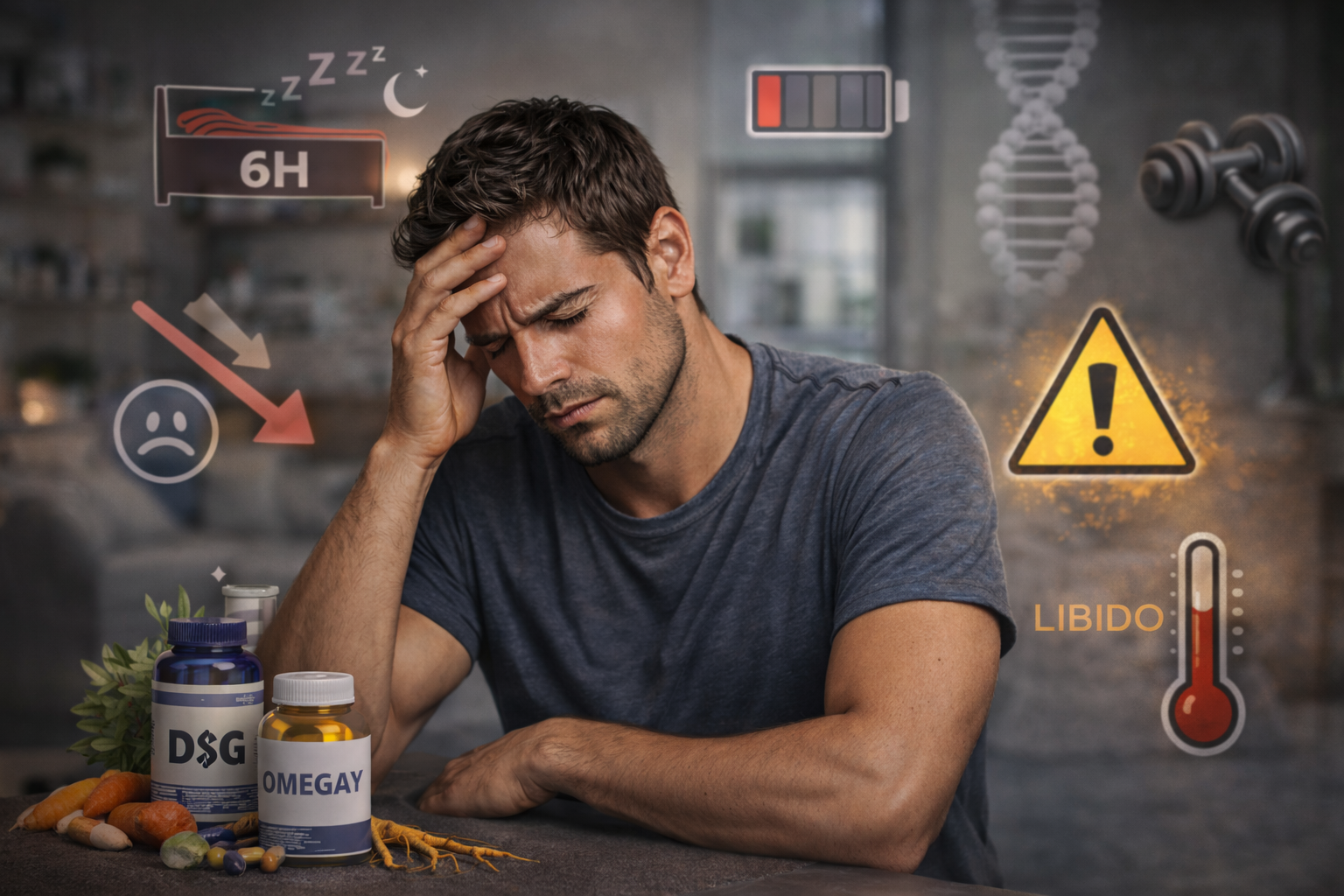
By the Primal Vitality Method Research Team Medically Reviewed by Dr. Marcus Chen, MD Last Updated: January 6, 2026
TL;DR — Quick Summary for Busy Readers
The Problem: Low testosterone affects 20-40% of men over 45, but most don’t recognize the symptoms. They blame aging, stress, or “just getting older”—missing a treatable condition that affects every aspect of life.
What You’ll Learn: 12 warning signs of low testosterone, a self-assessment quiz to evaluate your risk, the science behind why T drops, and a complete action plan for naturally restoring healthy levels.
The Bottom Line: Low T is not an inevitable part of aging. It’s a medical condition with identifiable symptoms and effective treatments—both natural and medical. Recognizing the signs is the first step to reclaiming your vitality.
Best For: Men experiencing unexplained fatigue, mood changes, sexual issues, or body composition changes who suspect something is “off.”
Skip to: The 12 Signs [blocked] | Self-Assessment Quiz [blocked] | Why T Drops [blocked] | What to Do [blocked]
Introduction: The Decline No One Warned You About
Something changed.
You can’t pinpoint exactly when it started, but you know things are different now.
The energy you used to have? Gone. That drive and ambition? Fading. Your body? Softer, weaker, harder to recognize. Your sex life? Let’s not talk about it.
You tell yourself it’s just stress. Just aging. Just life.
But what if it’s something else?
What if there’s a specific, measurable reason you feel this way—and what if it’s fixable?
For millions of men, that reason is low testosterone.
Here’s what most men don’t realize:
- 20-40% of men over 45 have clinically low testosterone [1]
- Most of them don’t know it
- The symptoms are often attributed to other causes
- And yet, low T is highly treatable
The problem isn’t just the condition itself—it’s the failure to recognize it. Men suffer for years, watching their quality of life deteriorate, never connecting the dots.
This guide changes that.
We’re going to cover the 12 most common signs of low testosterone—how they manifest, why they happen, and what distinguishes them from normal aging. We’ll give you a self-assessment tool to evaluate your own risk and a clear action plan for what to do next.
Because the first step to fixing a problem is recognizing you have one.
Let’s find out what your body is trying to tell you.
Understanding Testosterone: The Master Male Hormone
Before we discuss the signs of low T, let’s understand what testosterone does—and why its decline affects so much.
What Testosterone Does in Your Body
Testosterone isn’t just about muscles and sex. It’s a systemic hormone affecting virtually every aspect of male health:
| System | Testosterone’s Role |
| Sexual function | Libido, erections, sperm production |
| Body composition | Muscle mass, fat distribution, bone density |
| Energy | Cellular metabolism, mitochondrial function |
| Brain function | Mood, motivation, cognitive clarity, memory |
| Cardiovascular | Red blood cell production, heart health |
| Metabolic | Insulin sensitivity, glucose metabolism |
| Immune | Immune function regulation |
| Sleep | Sleep quality and architecture |
When testosterone drops, all of these systems are affected. This is why low T produces such a wide range of symptoms.
Normal Testosterone Levels
| Measurement | Normal Range | Optimal Range | Low T Threshold |
| Total Testosterone | 300-1000 ng/dL | 500-800 ng/dL | Below 300 ng/dL |
| Free Testosterone | 5-21 pg/mL | 15-25 pg/mL | Below 5 pg/mL |
Important Distinctions:
- Total T: All testosterone in blood (bound and unbound)
- Free T: Unbound testosterone actually available for use (1-3% of total)
- Bioavailable T: Free T + loosely bound T (about 30-40% of total)
You can have “normal” total T but low free T if SHBG (Sex Hormone-Binding Globulin) is high. This is why comprehensive testing matters.
The Natural Decline
Testosterone naturally peaks in late teens/early 20s, then gradually declines:
| Age | Average Decline from Peak |
| 30 | Beginning of decline (~1-2%/year) |
| 40 | 10-20% below peak |
| 50 | 20-30% below peak |
| 60 | 30-40% below peak |
| 70 | 40-50% below peak |
But here’s the critical point: “Normal decline” doesn’t mean you have to feel terrible. Many men maintain healthy T levels well into old age. The goal isn’t to have the testosterone of a 20-year-old—it’s to maintain levels that support good health and quality of life.
The 12 Warning Signs of Low Testosterone
These signs often appear gradually, making them easy to dismiss. Pay attention to patterns—especially if you notice multiple symptoms.
Sign #1: Persistent Fatigue and Low Energy
The #1 complaint among men with low testosterone.
What It Feels Like
- Tired even after adequate sleep
- Need caffeine just to function
- Energy crashes in the afternoon
- Feeling physically drained after minor activities
- Everything feels like effort
- “Running on empty” sensation
Why It Happens
Testosterone plays a direct role in cellular energy production:
- Supports mitochondrial function (cellular powerhouses)
- Influences red blood cell production (oxygen delivery)
- Affects metabolic rate
- Impacts motivation and drive (which feels like “energy”)
How to Distinguish from Normal Fatigue
| Normal Fatigue | Low T Fatigue |
| Improves with rest | Doesn’t improve with rest |
| Related to specific cause (poor sleep, overwork) | Persistent without clear cause |
| Temporary | Chronic (weeks to months) |
| Responds to lifestyle changes | Doesn’t respond to lifestyle changes alone |
Red Flag Level: 🔴 HIGH
If you’re persistently exhausted despite adequate sleep and have other symptoms on this list, low T is a likely contributor.
Sign #2: Decreased Libido (Low Sex Drive)
One of the most specific and sensitive indicators of low testosterone.
What It Feels Like
- Little to no interest in sex
- Don’t think about sex like you used to
- Partner initiates more than you do
- Sexual thoughts are infrequent
- Could “take it or leave it”
- Masturbation interest decreased
Why It Happens
Testosterone directly drives male sexual desire. It:
- Activates brain regions associated with sexual arousal
- Maintains sensitivity to sexual stimuli
- Supports dopamine pathways involved in desire
- Creates the “urge” for sexual activity
How to Distinguish from Other Causes
| Low T Libido | Stress-Related Low Libido | Relationship-Related |
| Persistent across situations | Improves with stress reduction | Partner-specific |
| Loss of sexual thoughts | Thoughts present but no energy | Desire for others may remain |
| Physical desire absent | Physical desire possible | Emotional component primary |
| Gradual decline | May be sudden | Often follows relationship changes |
Red Flag Level: 🔴 HIGH
Decreased libido is one of the most reliable indicators of low T, especially when combined with other symptoms.
Sign #3: Erectile Dysfunction
While not always caused by low T, erectile issues are common with testosterone deficiency.
What It Feels Like
- Difficulty achieving erections
- Difficulty maintaining erections
- Erections not as firm as before
- Fewer spontaneous erections
- Decreased morning erections
- Requires more stimulation to achieve erection
Why It Happens
Testosterone contributes to erectile function through:
- Maintaining nitric oxide production
- Supporting blood vessel health
- Preserving nerve sensitivity
- Driving the arousal that initiates erections
- Maintaining penile tissue health
Important Distinction
ED can have many causes beyond low T:
- Cardiovascular disease
- Diabetes
- Medications
- Psychological factors
- Nerve damage
However: If ED is accompanied by low libido and other low T symptoms, testosterone is likely a contributor.
The Morning Erection Test
Healthy men have 3-5 erections during sleep (nocturnal penile tumescence). Morning erections are the ones you notice.
| Morning Erections | Likely Meaning |
| Regular and firm | Vascular and nerve function intact |
| Occasional, less firm | Possible early T decline or vascular issues |
| Rare or absent | Likely physical cause (low T, vascular, or both) |
Red Flag Level: 🟡 MEDIUM-HIGH
ED with low libido strongly suggests low T. ED alone requires investigation but has multiple possible causes.
Sign #4: Loss of Muscle Mass
Testosterone is essential for building and maintaining muscle tissue.
What It Feels Like
- Muscles look smaller or less defined
- Strength declining despite training
- Workouts don’t produce results like before
- Arms, chest, shoulders losing size
- Feel “softer” overall
- Recovery from workouts is prolonged
Why It Happens
Testosterone:
- Stimulates protein synthesis in muscle
- Activates satellite cells for muscle repair
- Reduces muscle breakdown
- Supports the hormonal environment for muscle building
When T drops, you shift toward catabolism (breakdown) rather than anabolism (building).
How to Distinguish from Detraining
| Low T Muscle Loss | Detraining/Aging |
| Occurs despite consistent training | Related to reduced training |
| Disproportionate to activity level | Proportionate to activity |
| Accompanied by other low T symptoms | Isolated symptom |
| Doesn’t respond to increased training | Responds to resumed training |
Red Flag Level: 🟡 MEDIUM
Muscle loss is common with low T but also occurs with aging and reduced activity. More significant when combined with other symptoms.
Sign #5: Increased Body Fat (Especially Belly Fat)
Low testosterone promotes fat storage, particularly around the midsection.
What It Feels Like
- Weight gain despite same diet
- Fat accumulating around belly
- Harder to lose weight than before
- “Spare tire” or “dad bod” developing
- Possible breast tissue development (gynecomastia)
- Body composition shifting from muscle to fat
Why It Happens
The testosterone-fat relationship is bidirectional:
Low T → More Fat:
- Decreased metabolic rate
- Reduced muscle mass (burns fewer calories)
- Changed fat storage patterns
- Insulin resistance promotion
More Fat → Lower T:
- Fat cells contain aromatase enzyme
- Aromatase converts testosterone to estrogen
- More fat = more conversion = lower T
- Creates a vicious cycle
The Gynecomastia Warning
Gynecomastia (male breast tissue development) is a strong indicator of hormonal imbalance—either low T, high estrogen, or both.
Signs:
- Breast tissue feels firm (not just fat)
- Sensitivity or tenderness in chest
- Visible enlargement of breast area
If you notice gynecomastia, get hormones tested—this is a significant warning sign.
Red Flag Level: 🟡 MEDIUM
Body composition changes are common but have multiple causes. More significant when combined with other symptoms or when gynecomastia is present.
Sign #6: Mood Changes (Depression, Irritability, Anxiety)
Testosterone significantly affects brain chemistry and mood regulation.
What It Feels Like
Depression-like symptoms:
- Low mood, flat affect
- Loss of enjoyment in activities
- Hopelessness about the future
- Social withdrawal
- Difficulty experiencing pleasure
Irritability:
- Short temper, snapping at people
- Low frustration tolerance
- Anger over minor things
- Feeling “on edge”
Anxiety:
- Worry and nervousness
- Feeling overwhelmed
- Difficulty relaxing
- Racing thoughts
Why It Happens
Testosterone affects mood through:
- Dopamine system modulation (pleasure, motivation)
- Serotonin system influence (mood stability)
- GABA receptor effects (calmness)
- Cortisol regulation (stress response)
- General brain energy and function
How to Distinguish from Clinical Depression
| Low T Mood Changes | Clinical Depression |
| Accompanied by physical low T symptoms | May occur without physical symptoms |
| Often includes irritability prominently | Sadness more prominent |
| Energy and libido specifically affected | More generalized symptoms |
| May respond to T optimization | Requires depression treatment |
| Onset often gradual with other T symptoms | May have specific triggers or pattern |
Important: Low T can cause depression, and they can coexist. If you’re experiencing significant depression, seek professional help regardless of the cause.
Red Flag Level: 🔴 HIGH
Mood changes significantly impact quality of life and are a common low T symptom. If combined with fatigue and libido changes, low T is very likely.
Sign #7: Brain Fog and Cognitive Issues
Testosterone supports brain function, memory, and mental clarity.
What It Feels Like
- Difficulty concentrating
- Memory problems (names, where you put things)
- Mental “cloudiness” or “fuzziness”
- Slower thinking and processing
- Trouble finding words
- Difficulty with complex tasks
- Decreased mental sharpness
Why It Happens
Testosterone supports cognitive function by:
- Protecting neurons from damage
- Supporting neurotransmitter production
- Maintaining blood flow to the brain
- Reducing inflammation
- Supporting myelin (nerve insulation)
Research shows that low T is associated with cognitive decline and may increase dementia risk [2].
How to Distinguish from Other Causes
Brain fog can result from many factors:
| Cause | Distinguishing Features |
| Low T | Combined with other low T symptoms, gradual onset |
| Sleep deprivation | Clearly related to poor sleep |
| Stress | Related to specific stressors |
| Thyroid issues | Often includes temperature sensitivity, weight changes |
| Nutritional deficiencies | B12, D, iron deficiencies have other symptoms |
Red Flag Level: 🟡 MEDIUM
Cognitive issues have many possible causes. More significant when combined with other low T symptoms.
Sign #8: Sleep Problems
Low testosterone disrupts sleep, and poor sleep further lowers testosterone—creating a vicious cycle.
What It Feels Like
- Difficulty falling asleep
- Waking frequently during the night
- Waking too early
- Sleep feels unrefreshing
- Increased snoring or sleep apnea
- Restlessness during sleep
Why It Happens
Testosterone and sleep have a bidirectional relationship:
Low T → Poor Sleep:
- Affects sleep architecture
- May increase sleep apnea risk
- Disrupts circadian rhythm
- Reduces time in deep sleep
Poor Sleep → Lower T:
- Most testosterone is produced during sleep
- Disrupted sleep = disrupted production
- Sleep apnea dramatically lowers T
- Creates self-perpetuating cycle
The Sleep Apnea Connection
Sleep apnea is extremely common in men over 40 and devastates testosterone levels.
Signs of sleep apnea:
- Loud snoring
- Witnessed breathing pauses
- Gasping or choking during sleep
- Morning headaches
- Excessive daytime sleepiness despite “enough” sleep
If you have sleep apnea and low T, treating the apnea may significantly improve testosterone without other interventions.
Red Flag Level: 🟡 MEDIUM
Sleep issues have multiple causes, but they both contribute to and result from low T. Investigate sleep apnea if present.
Sign #9: Reduced Bone Density
Testosterone is essential for maintaining bone strength. Low T increases fracture risk.
What It Feels Like
Most men don’t feel bone density loss until they experience:
- A fracture from minor trauma
- Loss of height
- Back pain (vertebral compression)
- Stooped posture
Why It Happens
Testosterone (and estrogen converted from T) maintains bone density by:
- Stimulating bone-forming cells (osteoblasts)
- Reducing bone-breakdown cells (osteoclasts)
- Maintaining calcium balance
- Supporting bone matrix protein production
Low T is a significant cause of osteoporosis in men—yet it’s often overlooked.
Risk Assessment
| Risk Factor | Impact |
| Age over 50 | Increased risk |
| Low T for multiple years | Significantly increased risk |
| Smoking | Accelerates bone loss |
| Excessive alcohol | Accelerates bone loss |
| Sedentary lifestyle | Reduced bone stimulation |
| Low body weight | Less mechanical stress on bones |
Testing
If you have low T, consider a DEXA scan (bone density measurement), especially if you’re over 50 or have been low T for an extended period.
Red Flag Level: 🟡 MEDIUM
Not a symptom you’ll feel until damage is done. Important to test for if low T is confirmed.
Sign #10: Hot Flashes and Night Sweats
Yes, men can experience hot flashes too—and it’s often a sign of hormonal imbalance.
What It Feels Like
- Sudden waves of heat
- Flushing (face, neck, chest)
- Sweating, especially at night
- Followed by chills
- Can be accompanied by rapid heartbeat
- Disrupts sleep
Why It Happens
Hot flashes result from hormonal imbalance affecting the hypothalamus (the body’s thermostat). When testosterone drops suddenly or significantly:
- Hypothalamic function is disrupted
- Temperature regulation becomes unstable
- Blood vessels dilate unexpectedly
- Heat dissipates rapidly (flushing, sweating)
When to Be Concerned
Hot flashes in men are not normal and warrant investigation. They can indicate:
- Significantly low testosterone
- Rapid testosterone decline
- Pituitary problems
- Other hormonal issues
- Side effects of certain medications
Red Flag Level: 🔴 HIGH
Hot flashes in men are uncommon and indicate significant hormonal disruption. See a doctor for evaluation.
Sign #11: Decreased Body Hair
Testosterone maintains male body hair patterns. Low T can reduce hair growth.
What It Feels Like
- Less facial hair growth (shaving less often)
- Thinning body hair (chest, arms, legs)
- Reduced armpit and pubic hair
- Hair grows more slowly
Why It Happens
Testosterone and DHT (dihydrotestosterone) stimulate hair follicles in androgen-sensitive areas. When these hormones decline:
- Hair follicles receive less stimulation
- Hair growth slows
- Hair may become finer or lighter
- Some hair may stop growing altogether
Important Distinction
Head hair loss (male pattern baldness) is different. Ironically, it’s caused by DHT sensitivity, not low testosterone. You can have low T and still go bald—or have high T and keep your hair.
We’re talking about body and facial hair, which requires testosterone to maintain.
Red Flag Level: 🟢 LOW-MEDIUM
Body hair changes are subtle and occur slowly. Not a primary diagnostic sign but can support other symptoms.
Sign #12: Reduced Motivation and Competitive Drive
Testosterone is linked to ambition, assertiveness, and competitive behavior.
What It Feels Like
- Don’t care about goals like you used to
- Lack of ambition or drive
- Less assertive and confident
- Don’t feel like competing or achieving
- Passive where you were once active
- Loss of “fire” or “edge”
- Comfortable with mediocrity
Why It Happens
Testosterone influences:
- Dopamine system (motivation, reward-seeking)
- Risk tolerance and confidence
- Assertiveness and dominance behaviors
- Goal-oriented behavior
- Response to competition
Research shows that testosterone rises before competition and increases further after winning—driving continued competitive behavior [3].
How to Distinguish from Burnout or Depression
| Low T | Burnout | Depression |
| Gradual decline, multiple physical symptoms | Related to overwork, may resolve with rest | Pervasive hopelessness |
| Loss of competitive drive specifically | Exhaustion in all areas | Loss of interest in everything |
| Present even when rested | Improves with recovery | Persistent regardless of circumstances |
| Other low T symptoms present | Often without low T symptoms | May or may not have other low T symptoms |
Red Flag Level: 🟡 MEDIUM
Loss of motivation is common in low T but also occurs with burnout, depression, and life circumstances. More significant with other low T symptoms.
Low Testosterone Self-Assessment Quiz
Rate each symptom from 0-3:
0 = Not present 1 = Mild / Occasional 2 = Moderate / Frequent 3 = Severe / Constant
| # | Symptom | Score (0-3) |
| 1 | Persistent fatigue despite adequate sleep | ___ |
| 2 | Decreased interest in sex / low libido | ___ |
| 3 | Erectile difficulties or less firm erections | ___ |
| 4 | Loss of muscle mass or strength | ___ |
| 5 | Increased body fat, especially belly | ___ |
| 6 | Depressed mood, irritability, or anxiety | ___ |
| 7 | Brain fog, poor concentration, or memory issues | ___ |
| 8 | Sleep problems (difficulty sleeping or unrefreshing sleep) | ___ |
| 9 | Hot flashes or night sweats | ___ |
| 10 | Decreased body or facial hair growth | ___ |
| 11 | Reduced motivation, drive, or competitiveness | ___ |
| 12 | Fewer or absent morning erections | ___ |
Total Score: ___
Interpretation
| Score | Risk Level | Recommendation |
| 0-8 | Low Risk | Low T unlikely to be primary issue. Monitor symptoms. |
| 9-16 | Moderate Risk | Low T possible. Consider blood testing. |
| 17-24 | High Risk | Low T likely. Get comprehensive hormone panel. |
| 25-36 | Very High Risk | Low T very likely. See doctor promptly for testing. |
Important Notes
- This quiz is a screening tool, not a diagnosis
- Blood testing is required to confirm low testosterone
- Other conditions can cause similar symptoms
- See a healthcare provider for proper evaluation
Why Testosterone Declines: The Science
Understanding why testosterone drops helps you address root causes—not just symptoms.
Natural Age-Related Decline
Testosterone naturally decreases approximately 1-2% per year after age 30. This is due to:
- Leydig cell decline — The cells that produce testosterone become less efficient
- Hypothalamic changes — Less GnRH signal to produce T
- Increased SHBG — More testosterone bound and unavailable
- Accumulated cellular damage — Oxidative stress affects testicular function
Accelerated Decline: Lifestyle Factors
Many men experience faster-than-normal decline due to modifiable factors:
| Factor | Impact on Testosterone | Mechanism |
| Obesity | 30-50% lower T | Fat converts T to estrogen via aromatase |
| Poor sleep | 10-15% lower T | Most T produced during sleep |
| Chronic stress | 10-20% lower T | Cortisol suppresses T production |
| Sedentary lifestyle | 15-20% lower T | No stimulus for T production |
| Poor diet | Variable | Nutrient deficiencies, blood sugar issues |
| Excessive alcohol | 10-30% lower T | Direct testicular toxicity |
| Environmental toxins | Variable | Endocrine disruptors |
| Medications | Variable | Many drugs lower T |
Medical Causes
Some men have low T due to medical conditions:
Primary Hypogonadism (testicular problem):
- Testicular injury
- Infection (mumps orchitis)
- Genetic conditions (Klinefelter syndrome)
- Cancer treatment (radiation, chemo)
- Undescended testicles
Secondary Hypogonadism (pituitary/hypothalamus problem):
- Pituitary tumors
- Head injury
- Inflammatory conditions
- Obesity (severe)
- Certain medications (opioids)
Why This Matters:
The cause determines the treatment. Lifestyle-induced low T may respond to lifestyle changes. Medical causes may require TRT or other interventions.
The Testosterone Testing Guide
If you suspect low T, testing is essential. Here’s what you need to know.
What to Test
Essential Tests:
| Test | What It Measures | Why It Matters |
| Total Testosterone | All T in blood | Basic screening measure |
| Free Testosterone | Unbound, active T | Better reflects available T |
| SHBG | Binding protein | High SHBG = less free T |
| LH (Luteinizing Hormone) | Pituitary signal | Distinguishes primary vs. secondary hypogonadism |
| FSH | Pituitary signal | Additional diagnostic info |
Helpful Additional Tests:
| Test | What It Measures | Why It Matters |
| Estradiol (E2) | Estrogen level | Can be elevated in low T, causes symptoms |
| Prolactin | Pituitary hormone | If elevated, can suppress T |
| TSH, Free T4 | Thyroid function | Thyroid issues cause similar symptoms |
| CBC (Complete Blood Count) | Blood cell counts | Low T can cause anemia |
| Metabolic Panel | Blood sugar, kidney, liver | Overall health assessment |
| PSA | Prostate marker | Baseline before any T treatment |
Testing Protocol
Timing Matters:
- Test in the morning (7-10 AM) — Testosterone peaks in morning
- Fasting — More consistent results
- Avoid alcohol 48 hours before test
- Avoid vigorous exercise 24 hours before test
- Get tested on a typical day — Illness can temporarily lower T
Confirm Low T:
If first test is low, retest to confirm before starting treatment. Testosterone fluctuates, and a single low reading isn’t definitive.
Interpreting Results
Total Testosterone:
| Level | Interpretation |
| Below 200 ng/dL | Severely low — definite treatment needed |
| 200-300 ng/dL | Low — treatment usually indicated |
| 300-400 ng/dL | Low-normal — treatment if symptomatic |
| 400-600 ng/dL | Normal — but may be suboptimal for some |
| 600-900 ng/dL | Optimal range for most men |
| Above 1000 ng/dL | High — unusual without supplementation |
Remember: Symptoms matter as much as numbers. A man at 350 ng/dL with significant symptoms may benefit from treatment, while a man at 350 with no symptoms may not need it.
Where to Get Tested
Options:
- Primary care physician — Can order tests, insurance may cover
- Urologist or endocrinologist — Specialists in hormone issues
- Men’s health clinic — Often more comprehensive approach
- Direct-to-consumer labs — Companies like LabCorp, Quest (walk-in or online order)
- Telehealth services — Online consultations with home testing kits
What to Do If You Have Low T Symptoms
You’ve taken the quiz, you recognize the symptoms—what now?
Step 1: Get Tested
Don’t guess. Get blood work to confirm whether testosterone is actually low. This guides all further decisions.
Step 2: Identify Contributing Factors
While waiting for results (or if results confirm low T), assess lifestyle factors:
Ask yourself:
- Am I sleeping 7-9 hours of quality sleep?
- Am I significantly overweight?
- Am I chronically stressed?
- Am I sedentary?
- Do I drink alcohol regularly?
- Am I on medications that might lower T?
- Do I have sleep apnea?
Step 3: Implement Natural Optimization
Regardless of test results, these strategies benefit nearly every man:
Sleep Optimization
- 7-9 hours nightly
- Consistent sleep/wake times
- Cool, dark, quiet room
- No screens before bed
- Address sleep apnea if present
Exercise Protocol
Resistance Training (3-4x weekly):
- Compound movements (squats, deadlifts, presses)
- Challenging weight (not easy)
- Progressive overload
Cardiovascular (3-4x weekly):
- 30-45 minutes moderate intensity
- Or 2x weekly HIIT sessions
Nutrition
- Adequate protein (0.8-1g per lb body weight)
- Healthy fats (olive oil, avocados, nuts, fatty fish)
- Moderate carbs (not very low-carb)
- Minimize processed foods and sugar
- Maintain healthy weight
Stress Management
- Daily relaxation practice
- Address chronic stressors
- Adequate leisure and recovery
- Consider adaptogens
Step 4: Targeted Supplementation
Certain supplements can support testosterone levels naturally:
Foundation:
- Vitamin D3 (5,000 IU) — Essential if deficient
- Zinc (30-45mg) — Required for T production
- Magnesium (400-600mg) — Supports T and sleep
Testosterone Support:
- Ashwagandha — Reduces cortisol, may increase T 10-22%
- Tongkat Ali — May increase T 15-37%
- Fenugreek — Supports T and libido
- Boron — May increase free T by reducing SHBG
Our Top Recommendation for Natural Testosterone Support
Vigortrix is our #1 recommendation for men with low T symptoms.
Why We Recommend It:
- Comprehensive testosterone support formula
- Multiple pathways addressed:
- Testosterone production support
- SHBG reduction (more free T)
- Cortisol management
- Estrogen balance
- Key ingredients included:
- Ashwagandha (KSM-66)
- Tongkat Ali
- Tribulus Terrestris
- Maca Root
- Essential minerals (Zinc, Magnesium)
- Quality manufacturing — GMP-certified, USA-made
- Money-back guarantee — Risk-free trial
Best For: Men with low T symptoms who want to try natural optimization before considering TRT.
→ Check Current Vigortrix Availability
For men whose low T symptoms include sexual issues:
ErecPower addresses both testosterone support AND sexual performance.
Why It Works: Low T often manifests as sexual dysfunction first. ErecPower provides comprehensive support for both the hormonal root cause and the immediate performance concerns.
Best For: Men with low T symptoms that prominently include erectile issues or low libido.
Step 5: Monitor and Reassess
After 8-12 weeks of natural optimization:
- How do symptoms compare to baseline?
- Retest testosterone levels
- Evaluate whether further intervention is needed
Step 6: Consider Medical Treatment If Needed
If natural methods don’t sufficiently improve symptoms and levels, medical options include:
Testosterone Replacement Therapy (TRT):
- Injections — Most common, typically weekly or bi-weekly
- Gels — Daily topical application
- Patches — Daily application
- Pellets — Implanted every 3-6 months
TRT Considerations:
| Pros | Cons |
| Effective at raising T levels | Lifelong commitment (suppresses natural production) |
| Usually resolves symptoms | Requires regular monitoring |
| Well-studied | Potential side effects (acne, sleep apnea, polycythemia) |
| Multiple delivery options | May affect fertility |
| Insurance coverage varies |
Who Should Consider TRT:
- Confirmed low T on multiple tests
- Significant symptoms affecting quality of life
- Natural methods haven’t worked after adequate trial
- No contraindications (certain cancers, severe sleep apnea, etc.)
Important: Work with a knowledgeable physician (endocrinologist, urologist, or men’s health specialist) who will monitor your levels and adjust treatment appropriately.
Frequently Asked Questions
How do I know if my symptoms are from low T or just aging?
“Normal” aging shouldn’t make you feel terrible. If you’re experiencing multiple symptoms on this list—especially fatigue, low libido, and mood changes—low T is worth investigating. Blood testing provides clarity.
Can I have low T in my 30s?
Yes. While less common, men in their 30s can have low testosterone due to:
- Obesity
- Chronic stress
- Poor sleep
- Medical conditions
- Medications
- Genetic factors
If you have symptoms, get tested regardless of age.
Will losing weight raise my testosterone?
Often, yes—significantly. Studies show that obese men who lose 10-15% of body weight can increase testosterone substantially [4]. In some cases, this is enough to resolve symptoms without other treatment.
How long does it take for natural methods to work?
Most men notice initial improvements in energy and mood within 2-4 weeks. More significant changes in body composition, libido, and testosterone levels typically take 8-12 weeks of consistent effort.
Can supplements really raise testosterone?
Yes, but modestly. The best-researched compounds (Ashwagandha, Tongkat Ali, etc.) show testosterone increases of 10-30% in studies. This can be meaningful for men with borderline or mildly low T, especially combined with lifestyle optimization.
Should I try natural methods before TRT?
Generally, yes—unless your levels are severely low (<200 ng/dL) or you have a medical cause. Natural methods address root causes and have no downsides. Give them 3-6 months of consistent effort before considering TRT.
Is TRT safe?
For most men with confirmed low T, TRT is safe when properly monitored. However, it requires lifelong commitment, regular blood work, and may have side effects. It’s not appropriate for everyone and shouldn’t be undertaken without medical supervision.
Will my insurance cover testosterone testing?
Usually, yes—especially if you have symptoms. Coverage for TRT varies more widely. Check with your insurance provider.
Can low T cause depression, or does depression cause low T?
Both. They have a bidirectional relationship. Low T can cause depressive symptoms, and depression can lower testosterone. Addressing both simultaneously often works best.
How often should I get my testosterone tested?
- Initial screening: Once if you have symptoms
- Confirmation: Retest if first result is low
- On treatment: Every 3-6 months initially, then annually when stable
- Natural optimization: Retest after 8-12 weeks to assess progress
The Bottom Line: Don’t Ignore the Signs
Let’s be clear about what we’ve covered:
Low testosterone is common, underdiagnosed, and treatable.
The 12 warning signs:
- 🔴 Persistent fatigue and low energy
- 🔴 Decreased libido
- 🟡 Erectile dysfunction
- 🟡 Loss of muscle mass
- 🟡 Increased body fat (especially belly)
- 🔴 Mood changes (depression, irritability, anxiety)
- 🟡 Brain fog and cognitive issues
- 🟡 Sleep problems
- 🔴 Hot flashes and night sweats
- 🟢 Decreased body hair
- 🟡 Reduced motivation and drive
- 🔴 Fewer morning erections
If you recognized yourself in multiple symptoms, take action:
- Get tested — Blood work confirms whether low T is the issue
- Address lifestyle factors — Sleep, exercise, weight, stress
- Optimize naturally — Supplements like Vigortrix can support testosterone
- Monitor progress — Retest and reassess after 8-12 weeks
- Consider medical treatment — If natural methods aren’t sufficient
The worst thing you can do is nothing.
Low T doesn’t improve on its own—it typically gets worse. The symptoms progressively affect your energy, your mood, your relationships, your career, and your health.
But it doesn’t have to be this way.
Whether through natural optimization, medical treatment, or a combination, testosterone can be restored. Men in their 60s, 70s, and beyond can have healthy, functional testosterone levels.
The first step is recognizing the signs.
You’ve done that. Now take action.
Ready to optimize your testosterone naturally?
References
[1] Mulligan, T., et al. (2006). Prevalence of hypogonadism in males aged at least 45 years: The HIM study. International Journal of Clinical Practice, 60(7), 762-769.
[2] Moffat, S.D., et al. (2004). Longitudinal assessment of serum free testosterone concentration predicts memory performance and cognitive status in elderly men. Journal of Clinical Endocrinology & Metabolism, 89(11), 5482-5487.
[3] Booth, A., et al. (1989). Testosterone, and winning and losing in human competition. Hormones and Behavior, 23(4), 556-571.
[4] Corona, G., et al. (2013). Body weight loss reverts obesity-associated hypogonadotropic hypogonadism: A systematic review and meta-analysis. European Journal of Endocrinology, 168(6), 829-843.
Medical Disclaimer
The information provided in this article is for educational and informational purposes only and is not intended as medical advice. Low testosterone can be caused by serious medical conditions requiring professional treatment.
Always consult with a qualified healthcare provider before starting any supplement regimen or making significant lifestyle changes. If you experience severe symptoms, sudden onset of symptoms, or symptoms that significantly impact your quality of life, seek medical evaluation promptly.
The self-assessment quiz is a screening tool only and cannot diagnose low testosterone. Blood testing is required for diagnosis.
Individual results may vary. The supplements and lifestyle changes discussed are not intended to diagnose, treat, cure, or prevent any disease.
Affiliate Disclosure
This article contains affiliate links. If you purchase products through these links, we may receive a commission at no additional cost to you. This helps support our research and allows us to continue providing free, evidence-based content.
Our recommendations are based on independent research and analysis—not commission rates. We only recommend products we believe can genuinely help our readers. For more information, see our full Affiliate Disclosure [blocked].
Last Updated: January 6, 2026 Written by: Primal Vitality Method Research Team Reviewed by: Dr. Marcus Chen, MD
