

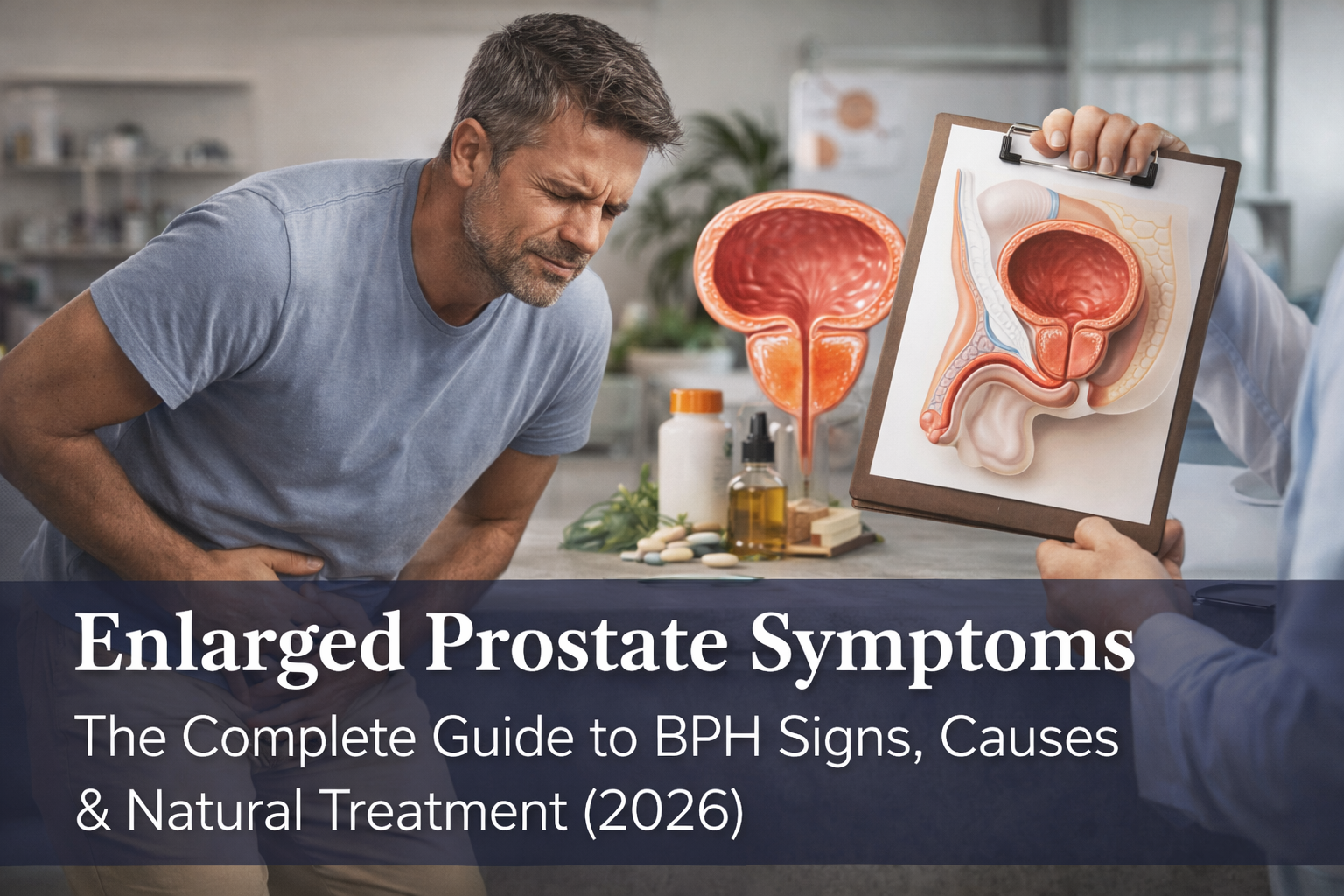
By the Primal Vitality Method Research Team Medically Reviewed by Dr. Marcus Chen, MD, FACS Last Updated: January 7, 2026
TL;DR — Quick Summary for Busy Readers
The Problem: Benign Prostatic Hyperplasia (BPH)—an enlarged prostate—affects 50% of men by age 50 and 90% by age 80. Most men don’t recognize the early warning signs until symptoms significantly impact quality of life.
What You’ll Learn: The complete list of BPH symptoms (early, moderate, and severe), what causes prostate enlargement, when to see a doctor, and 12 evidence-based natural treatments that can shrink your prostate and restore normal urinary function.
The Bottom Line: An enlarged prostate is not inevitable, and symptoms don’t have to control your life. Early intervention with natural approaches can prevent progression and restore comfort.
Best For: Men 40+ experiencing urinary changes, frequent nighttime urination, weak stream, or other prostate-related symptoms.
Skip to: Symptoms by Stage [blocked] | Causes [blocked] | Self-Assessment [blocked] | Natural Treatments [blocked] | Supplements [blocked]
Introduction: The Problem No One Wants to Talk About
It starts so gradually you barely notice.
You’re waking up once at night to urinate. Then twice. Then three times.
Your urine stream isn’t as strong as it used to be. You stand at the urinal waiting for things to start. When you finish, you’re not sure you’re actually finished.
You plan road trips around bathroom stops. You scope out restrooms before movies. You avoid certain drinks because you know what’s coming.
And you tell yourself: “It’s just age. Nothing I can do about it.”
Wrong.
What you’re experiencing likely has a name: Benign Prostatic Hyperplasia (BPH)—commonly called an enlarged prostate. And while it’s extremely common, it’s far from inevitable or untreatable.
The numbers are staggering:
- 50% of men have BPH by age 50 [1]
- 70% of men have it by age 60
- 90% of men have it by age 80
- Yet most men suffer in silence, unaware that effective treatments exist
Here’s what most men don’t realize:
BPH is progressive. Without intervention, symptoms typically worsen over time. What starts as minor inconvenience can become serious—urinary retention, bladder damage, kidney problems, even emergency surgery.
But BPH is also treatable. Natural approaches can significantly reduce symptoms, slow progression, and in many cases, shrink the prostate itself.
This guide covers everything you need to know:
- The complete symptom list (so you know what to watch for)
- What actually causes prostate enlargement
- When symptoms are serious (and when to see a doctor)
- 12 evidence-based natural treatments
- A complete protocol for prostate health
Your comfort—and your sleep—don’t have to suffer.
Let’s take control of your prostate health.
Understanding the Prostate: Anatomy and Function
Before we discuss what goes wrong, let’s understand what the prostate actually does.
What Is the Prostate?
The prostate is a walnut-sized gland located just below the bladder, surrounding the urethra (the tube that carries urine from bladder to penis).
Primary functions:
- Produces prostatic fluid (30% of semen volume)
- Nourishes and protects sperm
- Contracts during ejaculation to propel semen
- Contains muscles that help control urination
Why Location Matters
Here’s the critical point: The prostate wraps around the urethra.
When the prostate enlarges, it squeezes the urethra—like stepping on a garden hose. This compression is what causes most BPH symptoms.
[Bladder] → [Prostate ○ ] → Urethra → Normal flow

Enlarged Prostate:
[Bladder] → [Prostate ◉ ] → Urethra (compressed) → Restricted flow
The Three Zones of the Prostate
| Zone | Location | Clinical Significance |
|---|---|---|
| Transition Zone | Surrounds urethra | Where BPH develops (95% of cases) |
| Central Zone | Around ejaculatory ducts | Rarely involved in disease |
| Peripheral Zone | Outer region | Where most prostate cancer develops |
Key Insight: BPH and prostate cancer typically develop in different zones. Having BPH does NOT increase your risk of prostate cancer—though both become more common with age and can coexist.
Enlarged Prostate Symptoms by Stage
BPH symptoms develop gradually and can be categorized by severity. Recognizing early signs allows for earlier intervention.
Early Stage Symptoms (Mild BPH)
These are often dismissed as “normal aging” but actually signal the beginning of prostate enlargement:
1. Increased Urinary Frequency
What It Feels Like: Needing to urinate more often than usual—typically more than 8 times in 24 hours.
Why It Happens: The compressed urethra prevents complete bladder emptying. Residual urine means the bladder fills faster.
Red Flag: If you’re urinating more than every 2 hours during the day.
2. Nocturia (Nighttime Urination)
What It Feels Like: Waking up 1-2 times per night to urinate when you previously slept through.
Why It Happens: Same mechanism as increased frequency, plus lying down redistributes fluid to the kidneys.
Red Flag: This is often the first symptom men notice. It disrupts sleep and causes daytime fatigue.
Important: Occasional nocturia can be caused by drinking fluids late, caffeine, or alcohol. Persistent nocturia (most nights) suggests BPH.
3. Urinary Urgency
What It Feels Like: Sudden, strong urge to urinate that’s difficult to delay—the “gotta go NOW” feeling.
Why It Happens: The bladder becomes irritated from incomplete emptying and overwork, becoming hypersensitive.
Impact: Creates anxiety about being near a bathroom. May lead to limiting activities.
4. Hesitancy (Difficulty Starting)
What It Feels Like: Standing at the toilet waiting for urine flow to begin. Having to concentrate or strain to start.
Why It Happens: The compressed urethra requires more bladder pressure to initiate flow.
Note: This is often more noticeable when you’re stressed or the bladder isn’t completely full.
Moderate Stage Symptoms (Progressive BPH)
As the prostate continues to enlarge, symptoms become more disruptive:
5. Weak Urine Stream
What It Feels Like: Reduced force and caliber of urine stream. Takes longer to empty bladder.
Why It Happens: Progressive urethral compression reduces flow rate.
Comparison: Think of the difference between a garden hose at full pressure versus partially kinked.
6. Intermittent Stream (Stop-Start)
What It Feels Like: Urine flow that stops and starts several times during urination.
Why It Happens: The bladder muscle fatigues during urination, or the prostate intermittently blocks flow.
7. Straining to Urinate
What It Feels Like: Needing to bear down or push with abdominal muscles to urinate.
Why It Happens: The bladder muscle alone isn’t strong enough to overcome the obstruction.
Warning: Chronic straining can lead to hernias, hemorrhoids, and bladder damage.
8. Sensation of Incomplete Emptying
What It Feels Like: Finishing urination but feeling like there’s still urine in your bladder. May feel urge to go again immediately.
Why It Happens: Residual urine actually remains in the bladder (often 50-100+ mL).
Consequence: The bladder is never fully empty, which can lead to infections and bladder stones.
9. Dribbling After Urination
What It Feels Like: Continued dribbling or leaking after you think you’re done, often causing embarrassing wet spots.
Why It Happens: Urine trapped in the compressed urethra releases after you leave the toilet.
Tip: “Milking” the urethra from base to tip can reduce post-void dribbling.
10. Increased Nocturia (2-4+ times/night)
What It Feels Like: Waking multiple times per night, severely disrupting sleep.
Impact: This is often the symptom that most affects quality of life—chronic sleep deprivation causes daytime fatigue, cognitive issues, and irritability.
Severe Stage Symptoms (Advanced BPH)
These symptoms indicate significant obstruction and require medical attention:
11. Urinary Retention
What It Feels Like: Inability to urinate despite a full bladder, or extreme difficulty passing any urine.
Types:
- Acute retention: Sudden complete inability to urinate (medical emergency)
- Chronic retention: Gradual inability to fully empty; may dribble small amounts
Why It Happens: Complete or near-complete obstruction of the urethra.
Action Required: Acute retention requires immediate medical care—catheterization may be necessary.
12. Overflow Incontinence
What It Feels Like: Constant dribbling or leaking because the bladder is always overfull.
Why It Happens: When the bladder can’t empty properly, it becomes overstretched. Urine “overflows” the obstruction.
13. Bladder Stones
What It Feels Like: Pain during urination, blood in urine, frequent UTIs.
Why It Happens: Stagnant urine in the bladder allows minerals to crystallize into stones.
14. Urinary Tract Infections
What It Feels Like: Burning during urination, cloudy or foul-smelling urine, fever.
Why It Happens: Residual urine provides breeding ground for bacteria.
Note: UTIs are uncommon in men—if you get them, prostate issues should be investigated.
15. Blood in Urine (Hematuria)
What It Feels Like: Pink, red, or brown urine; may be visible or only detectable on tests.
Why It Happens: Enlarged prostate tissue has increased blood vessels that can bleed with straining.
Important: Blood in urine should always be evaluated by a doctor to rule out other causes.
16. Kidney Problems
What It Feels Like: May have no symptoms initially; can include back pain, fatigue, swelling.
Why It Happens: Chronic urinary retention creates back-pressure that can damage kidneys over time.
This is why BPH shouldn’t be ignored—untreated, it can lead to permanent kidney damage.
Symptom Summary Table
| Symptom | Stage | Urgency |
|---|---|---|
| Increased frequency | Early | Monitor |
| Nocturia (1-2x) | Early | Monitor |
| Urgency | Early-Moderate | Address |
| Hesitancy | Early-Moderate | Address |
| Weak stream | Moderate | Address |
| Intermittent stream | Moderate | Address |
| Straining | Moderate | Address |
| Incomplete emptying | Moderate | Address |
| Dribbling | Moderate | Address |
| Nocturia (3+x) | Moderate-Severe | Treat |
| Urinary retention | Severe | Urgent |
| Overflow incontinence | Severe | Urgent |
| Bladder stones | Severe | Medical care |
| Recurrent UTIs | Severe | Medical care |
| Blood in urine | Any | Medical evaluation |
| Kidney problems | Severe | Medical care |
Prostate Symptom Self-Assessment (IPSS Score)
The International Prostate Symptom Score (IPSS) is the standard tool used by urologists to assess BPH severity. Take this assessment to understand where you stand.
Instructions
For each question, select the answer that best describes your experience over the past month.
Scoring:
- 0 = Not at all
- 1 = Less than 1 time in 5
- 2 = Less than half the time
- 3 = About half the time
- 4 = More than half the time
- 5 = Almost always
Question 1: Incomplete Emptying Over the past month, how often have you had the sensation of not emptying your bladder completely after urinating?
| 0 | 1 | 2 | 3 | 4 | 5 |
Question 2: Frequency Over the past month, how often have you had to urinate again less than 2 hours after you finished urinating?
| 0 | 1 | 2 | 3 | 4 | 5 |
Question 3: Intermittency Over the past month, how often have you found you stopped and started again several times when you urinated?
| 0 | 1 | 2 | 3 | 4 | 5 |
Question 4: Urgency Over the past month, how often have you found it difficult to postpone urination?
| 0 | 1 | 2 | 3 | 4 | 5 |
Question 5: Weak Stream Over the past month, how often have you had a weak urinary stream?
| 0 | 1 | 2 | 3 | 4 | 5 |
Question 6: Straining Over the past month, how often have you had to push or strain to begin urination?
| 0 | 1 | 2 | 3 | 4 | 5 |
Question 7: Nocturia Over the past month, how many times did you most typically get up at night to urinate?
| 0 (None) | 1 (1 time) | 2 (2 times) | 3 (3 times) | 4 (4 times) | 5 (5+ times) |
Calculate Your IPSS Score
Total Score: _____ / 35
Score Interpretation
| Score | Severity | Recommendation |
|---|---|---|
| 0-7 | Mild | Watchful waiting + lifestyle changes |
| 8-19 | Moderate | Active treatment recommended |
| 20-35 | Severe | Medical evaluation + treatment essential |
Quality of Life Question
If you were to spend the rest of your life with your urinary condition the way it is now, how would you feel about that?
| Score | Response |
|---|---|
| 0 | Delighted |
| 1 | Pleased |
| 2 | Mostly satisfied |
| 3 | Mixed feelings |
| 4 | Mostly dissatisfied |
| 5 | Unhappy |
| 6 | Terrible |
This question matters: Even men with “mild” IPSS scores may have poor quality of life. Treatment decisions should consider both symptom severity AND quality of life impact.
What Causes an Enlarged Prostate?
Understanding the causes helps you target treatments effectively.
The Primary Cause: Hormonal Changes
As men age, hormonal balance shifts:
Testosterone decreases:
- Drops 1-2% per year after age 30
- Total testosterone declines, but…
DHT (Dihydrotestosterone) remains active:
- DHT is converted from testosterone by 5-alpha reductase enzyme
- DHT stimulates prostate cell growth
- Even as testosterone drops, DHT continues affecting the prostate
Estrogen increases (relatively):
- Testosterone-to-estrogen ratio shifts
- Estrogen may promote prostate growth
- Increased in overweight men (fat converts T to estrogen)
The Growth Pattern
The prostate goes through two main growth phases:
- Puberty: Prostate doubles in size (~10g to ~20g)
- After age 25: Slow, continuous growth begins
- By age 50: Prostate may reach 30-40g
- By age 80: Can exceed 100g in some men
Key Insight: Prostate size doesn’t always correlate with symptoms. A moderately enlarged prostate growing inward can cause more obstruction than a larger one growing outward.
Contributing Factors
| Factor | Mechanism | Impact |
|---|---|---|
| Age | Hormonal changes, accumulated growth | Primary factor |
| Family history | Genetic predisposition | Men with affected fathers/brothers have higher risk |
| Obesity | Increases estrogen, inflammation | Strong association |
| Diabetes | Insulin resistance affects prostate | Increased risk |
| Sedentary lifestyle | Reduces blood flow, increases inflammation | Moderate association |
| Diet | High-fat, low-vegetable diets | Associated with BPH |
| Inflammation | Chronic prostatic inflammation | May drive growth |
| Metabolic syndrome | Cluster of risk factors | Strong association |
What Doesn’t Cause BPH
Common myths debunked:
- Sexual activity: Does NOT cause or prevent BPH
- Vasectomy: Does NOT increase BPH risk
- Prostate cancer: BPH does NOT cause or increase cancer risk (they’re separate conditions)
When to See a Doctor
While natural treatments are effective for many men, certain situations require medical evaluation:
See a Doctor Promptly If You Experience:
🚨 Emergency — Seek Immediate Care:
- Complete inability to urinate (acute retention)
- Severe pain with inability to urinate
- Fever with urinary symptoms (possible serious infection)
⚠️ Schedule Soon — Within Days:
- Blood in urine
