

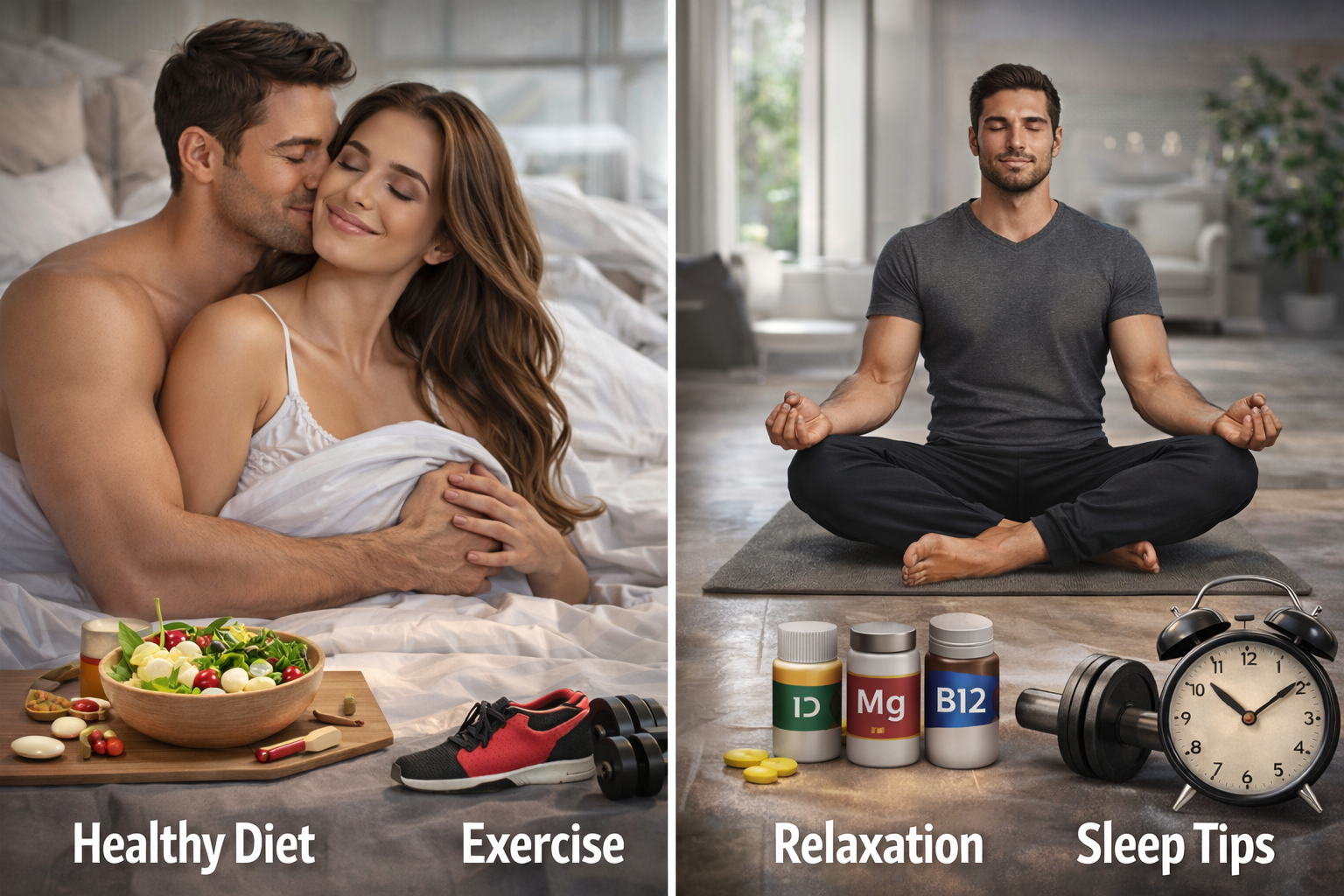
By the Primal Vitality Method Research Team Medically Reviewed by Dr. Marcus Chen, MD Last Updated: January 6, 2026
TL;DR — Quick Summary for Busy Readers
The Problem: Premature ejaculation affects 30-40% of men at some point, but most advice online is either outdated, ineffective, or just plain wrong.
What You’ll Learn: 17 science-backed techniques across 4 categories—physical methods, mental strategies, lifestyle changes, and natural supplements—that can help you last 2-5x longer starting tonight.
The Bottom Line: Lasting longer isn’t about numbing sprays or “thinking about baseball.” It’s about understanding your arousal system and training it strategically. This guide gives you the complete roadmap.
Best For: Men who want real solutions, not quick fixes that kill sensation or require a prescription.
Skip to: Physical Techniques [blocked] | Mental Strategies [blocked] | Lifestyle Changes [blocked] | Natural Supplements [blocked]
Introduction: Let’s Talk About the Elephant in the Bedroom
Here’s something nobody tells you:
Finishing too fast doesn’t mean something is wrong with you.
It means your body is doing exactly what evolution designed it to do—reproduce quickly. For thousands of years, that was a survival advantage. In the modern bedroom? Not so much.
The disconnect between biology and expectation creates frustration, embarrassment, and relationship strain for millions of men. Studies suggest that 30-40% of men experience premature ejaculation at some point in their lives, making it the most common male sexual dysfunction [1].
Yet most men suffer in silence.
They try the old “think about something unsexy” trick (which kills the mood and rarely works). They buy numbing sprays (which remove all sensation). They avoid intimacy altogether (which damages relationships).
There’s a better way.
After analyzing decades of clinical research and real-world results, we’ve compiled 17 techniques that actually work—methods that help you last longer while increasing pleasure, not eliminating it.
This isn’t about becoming a “sex robot” with no feeling. It’s about developing conscious control over your arousal, so you decide when to finish—not your nervous system.
Let’s get into it.
Understanding Your Arousal System (Why You Finish Fast)
Before we discuss solutions, you need to understand the problem.
The Arousal Curve Explained
Your sexual arousal operates on a curve from 0 (completely unaroused) to 10 (point of no return/orgasm).
0-3: Low arousal. Easy to control.
4-6: Medium arousal. Still manageable with awareness.
7-8: High arousal. Control becomes difficult.
9: Edge zone. Requires skill to stay here.
10: Point of no return. Ejaculation is inevitable.
The Problem: Most men who finish quickly spend their entire sexual experience in the 7-10 zone. They go from 0 to 8 in seconds, then try desperately to hold back the inevitable.
The Solution: Learn to spend more time in the 4-7 zone, where sensation is high but control is still possible. This is where great sex happens.
The Two Types of Premature Ejaculation
Lifelong (Primary) PE: You’ve always finished quickly, since your first sexual experiences. This is often related to nervous system sensitivity and responds well to training techniques.
Acquired (Secondary) PE: You used to last longer, but now finish faster. This can be caused by stress, relationship issues, erectile concerns, hormonal changes, or health conditions.
Important: If you’ve experienced a sudden change in ejaculatory control, consult a healthcare provider to rule out underlying causes.
What Actually Controls Ejaculation
Ejaculation is controlled by your autonomic nervous system—specifically the balance between:
Sympathetic nervous system: The “gas pedal.” Drives arousal toward climax. Activated by excitement, anxiety, and stimulation.
Parasympathetic nervous system: The “brake pedal.” Promotes relaxation and delays climax. Activated by deep breathing, relaxation, and feeling safe.
Key Insight: Most men who finish quickly are stuck with their foot on the gas pedal. The techniques in this guide teach you how to use the brake—without losing the enjoyment of the ride.
Physical Techniques That Work Tonight
These are practical methods you can implement immediately. No pills, no prescriptions, no waiting.
Technique 1: The Start-Stop Method
What It Is: Stimulation until you reach a 7-8 on the arousal scale, then complete pause until you drop to 4-5. Repeat.
How to Practice:
- Begin self-stimulation or intercourse
- Pay attention to your arousal level (the 0-10 scale)
- When you reach 7-8, stop ALL stimulation
- Stay still and breathe deeply until arousal drops to 4-5
- Resume stimulation
- Repeat 3-5 times before allowing climax
Why It Works: This trains your brain to recognize the “edge” and builds neural pathways for control. Over time, your threshold increases.
Success Rate: Studies show 45-65% improvement in ejaculatory control after 4-8 weeks of consistent practice [2].
Pro Tip: Practice solo first. It’s easier to learn control without the added stimulation and pressure of a partner.
Technique 2: The Squeeze Technique
What It Is: Applying firm pressure to the base of the penis head when approaching climax.
How to Practice:
- During stimulation, recognize when you’re approaching the point of no return
- Stop stimulation completely
- Squeeze the area where the head meets the shaft firmly (but not painfully) for 10-20 seconds
- Wait for arousal to decrease (30-60 seconds)
- Resume activity
- Repeat as needed
Why It Works: The squeeze interrupts the ejaculatory reflex and reduces arousal quickly. Originally developed by Masters and Johnson in the 1970s, it remains one of the most effective physical techniques.
Success Rate: 60-90% of men report significant improvement with regular use [3].
Note: Can be incorporated into partner play naturally—just communicate what you’re doing.
Technique 3: Strategic Muscle Control (Kegels for Men)
What It Is: Strengthening the pelvic floor muscles that control ejaculation.
How to Find the Right Muscles:
- When urinating, stop the flow midstream
- The muscles you just used are your pelvic floor muscles
- You can also feel them by trying to “lift” your testicles without using your hands
The Exercise Protocol:
Week 1-2: Contract and hold for 3 seconds, relax for 3 seconds. Do 10 reps, 3 times daily.
Week 3-4: Increase hold time to 5 seconds. Do 15 reps, 3 times daily.
Week 5+: Hold for 10 seconds. Do 20 reps, 3 times daily.
Why It Works: Strong pelvic floor muscles give you a “manual override” for ejaculation. When you feel climax approaching, a strong contraction can delay it.
The Research: A 2014 study found that 82.5% of men who practiced pelvic floor exercises gained significant control over their ejaculatory reflex [4].
Advanced Technique: Practice “reverse Kegels” (pushing out instead of contracting) during sex to release tension and delay arousal.
Technique 4: Edging
What It Is: Intentionally bringing yourself to the edge of orgasm repeatedly without finishing.
How to Practice:
- Stimulate yourself until you reach 9 on the arousal scale
- Stop completely and let arousal drop to 5-6
- Resume and climb back to 9
- Repeat for 15-30 minutes before allowing climax
Why It Works: Edging expands your tolerance for high arousal states and trains your nervous system to stay calm near the edge. It also typically results in more intense orgasms when you do finish.
Frequency: Practice 2-3 times per week for best results.
Partner Integration: Edging with a partner can become an erotic game that benefits both of you. Communicate openly about what you’re doing.
Technique 5: Position Changes
What It Is: Using body positioning to control stimulation intensity.
Positions That Help You Last Longer:
Woman on top: You have less control over thrusting speed, but your pelvic muscles are more relaxed. You can also gently guide her rhythm.
Side by side (spooning): Lower intensity stimulation. Great for longer sessions.
Modified missionary: Instead of thrusting, focus on grinding motions. Less intense stimulation of the frenulum (most sensitive area).
Standing positions: Requires more effort and blood flow to legs, which can redirect some energy away from arousal.
Positions That Tend to Accelerate Climax:
Doggy style: Deep penetration and visual stimulation often accelerate arousal.
Missionary with her legs up: Maximum depth and stimulation.
Pro Tip: Create a “position sequence” that starts with less intense positions and progresses to more intense ones as you gain control during the session.
Technique 6: Breathing Control
What It Is: Using specific breathing patterns to regulate your nervous system.
The Problem: When aroused, most men breathe rapidly and shallowly. This activates the sympathetic nervous system (gas pedal) and accelerates climax.
The Solution: Slow, deep diaphragmatic breathing activates the parasympathetic system (brake pedal).
4-7-8 Breathing Technique:
- Inhale through your nose for 4 seconds
- Hold for 7 seconds
- Exhale through your mouth for 8 seconds
- Repeat
During Sex Application:
- When you feel arousal climbing too fast, slow down movement
- Take 3-5 deep breaths, focusing on extending the exhale
- Feel your arousal level decrease
- Resume with slower breathing maintained
Why It Works: Breathing is the one autonomic function you can control consciously. It’s your direct line to the nervous system.
Technique 7: Temperature Manipulation
What It Is: Using temperature changes to reduce arousal when needed.
Methods:
Cool down before: A cool (not cold) shower before sex can slightly reduce initial sensitivity.
Keep the room cooler: Higher temperatures tend to increase arousal. A slightly cooler room can help you last longer.
Cool cloth nearby: Some men keep a cool, damp cloth by the bed. A brief application to the forehead or chest can help reset arousal.
Why It Works: Cooler temperatures activate the parasympathetic nervous system and slightly reduce blood flow to the genitals, decreasing sensitivity.
Note: This is a subtle technique—don’t make yourself uncomfortable. The goal is slight temperature reduction, not discomfort.
Mental Strategies for Ejaculation Control
Physical techniques work on the body. Mental strategies work on the mind—which is where arousal actually originates.
Technique 8: Sensate Focus (The Awareness Technique)
What It Is: A mindfulness-based approach that shifts focus from performance to sensation.
The Problem: Anxiety about lasting longer creates a self-fulfilling prophecy. The more you worry about finishing fast, the faster you finish.
The Practice:
- During sexual activity, focus entirely on physical sensations
- Notice the specific feelings—warmth, pressure, texture, rhythm
- When your mind wanders to performance concerns, gently redirect to sensation
- Rate your arousal level periodically (this builds awareness)
Why It Works: Performance anxiety triggers the sympathetic nervous system. Sensate focus interrupts anxiety by directing attention to present-moment sensation.
The Research: Developed by Masters and Johnson, sensate focus remains a cornerstone of sex therapy with decades of clinical support [5].
Technique 9: The 9-1 Arousal Scale Training
What It Is: A mental rating system that builds ejaculatory awareness.
How to Practice:
- During any sexual activity, continuously rate your arousal from 1-10
- Say the number to yourself (or out loud with a partner)
- Goal: Never let yourself get past 8 without a conscious choice
Why It Works: Most men who finish quickly have poor awareness of their arousal level. They go from “feeling good” to “too late” with nothing in between. This technique builds the middle awareness that enables control.
Partner Integration: Telling your partner your number can become part of intimacy. “I’m at a 7” signals when to slow down. Some couples find this communication enhances connection.
Technique 10: Cognitive Reframing
What It Is: Changing how you mentally frame the sexual experience.
Harmful Frames:
- “I need to last as long as possible”
- “Finishing fast means I’m bad at sex”
- “My partner will be disappointed if I don’t last”
Helpful Frames:
- “Good sex is about connection, not duration”
- “My control is improving with practice”
- “We can always go for round two”
- “There are many ways to satisfy my partner”
Key Insight: The pressure you put on yourself is often greater than any pressure your partner puts on you. Studies show that women rate relationship satisfaction and emotional connection higher than duration when evaluating sexual satisfaction [6].
Technique 11: Visualization Training
What It Is: Mental rehearsal of successful sexual experiences.
The Practice:
- Find a quiet place and close your eyes
- Visualize a sexual scenario in detail
- Imagine yourself calm, controlled, and confident
- Visualize recognizing your arousal levels clearly
- See yourself using control techniques successfully
- End the visualization with mutual satisfaction
Frequency: 5-10 minutes daily, especially before anticipated sexual activity.
Why It Works: The brain doesn’t fully distinguish between vivid visualization and real experience. Mental rehearsal builds the same neural pathways as physical practice [7].
Technique 12: The Distraction Method (Upgraded)
What It Is: A strategic mental shift to briefly lower arousal.
The Old Way (Doesn’t Work Well): Think about baseball, dead puppies, your grandmother. Problem: This completely disconnects you from the experience and kills intimacy.
The Better Way:
- When arousal spikes, shift focus to your partner’s pleasure
- Notice their breathing, sounds, expressions
- Think about what they’re feeling, not what you’re feeling
- This reduces your arousal while increasing connection
Why It Works: You stay present in the experience (maintaining intimacy) while shifting the arousal spotlight away from yourself.
Alternative: Focus on a non-genital sensation—the feeling of their hands on your back, the smell of their hair, the sound of their breathing.
Lifestyle Factors That Affect Stamina
These aren’t quick fixes, but they create the foundation for long-term improvement.
Technique 13: Masturbation Strategy
What Most Men Do Wrong:
- Rush to finish as fast as possible
- Use death grip (too much pressure)
- Focus only on orgasm, not the journey
What to Do Instead:
Practice edging: Use solo time to practice the techniques in this guide.
Use less pressure: A lighter grip more closely mimics intercourse and improves sensitivity calibration.
Extend the session: Aim for 15-20+ minutes. This trains your body to tolerate arousal.
Time it strategically: Some men find that masturbating 1-3 hours before sex helps them last longer during partnered activity. Experiment to find your optimal timing.
Technique 14: Exercise and Cardiovascular Health
The Connection: Sexual stamina is partly about physical stamina. Poor cardiovascular fitness means:
- Faster fatigue during sex
- Higher baseline stress hormones
- Less blood flow control
- Lower overall endurance
Exercise Protocol for Sexual Performance:
Cardiovascular: 150+ minutes per week of moderate intensity (brisk walking, cycling, swimming)
Strength training: 2-3 sessions per week, focusing on core, glutes, and legs
HIIT: High-intensity interval training improves anaerobic capacity—useful for intense moments
Specific exercises that help:
- Squats and deadlifts (pelvic strength, testosterone)
- Planks and core work (endurance in common positions)
- Hip flexor stretches (better range of motion)
Technique 15: Stress Management
The Connection: Chronic stress elevates cortisol, which:
- Reduces testosterone
- Increases anxiety
- Activates the sympathetic nervous system (remember—the gas pedal)
- Creates a hyperaroused state that accelerates ejaculation
Stress Reduction Strategies:
- Daily meditation or deep breathing practice (10+ minutes)
- Regular exercise
- Adequate sleep (7-9 hours)
- Limiting caffeine (especially after noon)
- Time in nature
- Social connection
Key Point: If you’re chronically stressed, no technique will fully compensate. Address the root cause.
Technique 16: Sleep Optimization
The Connection: Poor sleep disrupts:
- Testosterone production (which peaks during deep sleep)
- Nervous system regulation
- Stress hormone balance
- Cognitive function (including control and awareness)
Sleep Recommendations:
- 7-9 hours per night
- Consistent sleep/wake times
- Cool, dark bedroom
- No screens 1 hour before bed
- Limit alcohol (disrupts sleep architecture)
The Research: Men with sleep disorders have significantly higher rates of sexual dysfunction, including premature ejaculation [8].
Natural Supplements for Lasting Longer
Lifestyle and techniques form the foundation. Strategic supplementation can accelerate results.
Technique 17: Evidence-Based Supplementation
Important Distinction: We’re not talking about “numbing” products or dangerous pharmaceuticals. We’re discussing natural compounds that support the physiological systems involved in ejaculatory control.
Key Systems to Support:
Serotonin balance: Low serotonin is linked to premature ejaculation. SSRIs (prescription antidepressants) work partly by increasing serotonin, but have significant side effects. Natural serotonin support is gentler.
Nervous system regulation: Adaptogens and calming compounds help balance the sympathetic/parasympathetic nervous system.
Hormonal optimization: Healthy testosterone levels support overall sexual function, including control.
Blood flow: Optimal circulation supports arousal quality, reducing the anxiety that often accelerates climax.
Natural Compounds With Evidence
Ashwagandha (Withania somnifera)
- Adaptogen that reduces cortisol and anxiety
- May improve ejaculation latency in stressed men
- Supports healthy testosterone levels
- Typical dose: 300-600mg daily (KSM-66 extract)
Zinc
- Essential for testosterone production
- Deficiency linked to sexual dysfunction
- Typical dose: 25-45mg daily
Magnesium
- Calms the nervous system
- Supports muscle relaxation (including pelvic floor)
- Many men are deficient
- Typical dose: 400-600mg daily (glycinate form)
Tribulus Terrestris
- Traditional aphrodisiac
- May support libido and sexual confidence
- Mixed evidence for testosterone, but positive user reports for sexual function
- Typical dose: 250-750mg daily
Maca Root
- Peruvian adaptogen
- Studies show improved sexual desire and potentially better stamina
- Typical dose: 1,500-3,000mg daily
L-Theanine
- Amino acid from tea
- Promotes calm alertness without sedation
- May help with performance anxiety
- Typical dose: 100-200mg before sexual activity
Our Recommended Supplement Stack for Lasting Longer
Rather than buying 6 different bottles, look for comprehensive formulas that combine these ingredients intelligently.
ErecPower is our top recommendation for men focused on sexual performance and stamina.
What’s Inside:
- Horny Goat Weed (Icariin) — Supports blood flow and libido
- Tongkat Ali — Traditional stamina enhancer
- Maca Root — Adaptogenic support for endurance
- L-Arginine — Circulation support
- Tribulus Terrestris — Libido and confidence
- Saw Palmetto — Prostate and hormonal health
Why We Recommend It:
- Addresses multiple pathways (blood flow, hormones, nervous system)
- Clinical doses, not proprietary blends
- 60-day money-back guarantee
- Manufactured in USA, GMP-certified
- Thousands of positive user reviews
Best For: Men who want comprehensive support for lasting longer, stronger erections, and overall sexual confidence.
→ Check Current ErecPower Availability
Vigortrix is our recommendation for men who want broader vitality support alongside sexual performance.
What’s Inside:
- Comprehensive adaptogen blend
- Testosterone-supporting nutrients
- Energy and stamina compounds
- Stress-management ingredients
Why We Recommend It:
- Holistic approach (sexual health + overall vitality)
- Good option for men also experiencing fatigue, low motivation
- Quality manufacturing standards
- Money-back guarantee
Best For: Men over 40 who want to address sexual stamina as part of overall vitality optimization.
Which Product Should You Choose?
Choose ErecPower if:
- Your primary concern is sexual performance specifically
- You want the most targeted formula for lasting longer
- You don’t have significant issues with energy or general fatigue
Choose Vigortrix if:
- You want to address sexual stamina AND overall energy
- You’re experiencing multiple signs of low vitality
- You prefer a comprehensive approach
Consider both if:
- You want maximum support across all pathways
- Budget allows for a complete stack
The 4-Week Training Protocol
Knowledge without action is useless. Here’s your step-by-step implementation plan.
Week 1: Foundation
Daily Practice:
- Pelvic floor exercises: 10 reps × 3 sets × 3 times daily
- Breathing practice: 5 minutes of 4-7-8 breathing
- Arousal awareness: Rate your arousal during any sexual thoughts (build the habit)
Solo Sessions (2-3x this week):
- Practice the start-stop method
- Time your sessions: Aim for 10+ minutes before climax
- Focus on recognizing arousal levels 1-10
Lifestyle:
- Begin supplement protocol if using (ErecPower or Vigortrix)
- Assess sleep quality—make one improvement
- Note current estimated time to climax (baseline)
Week 2: Skill Building
Daily Practice:
- Pelvic floor exercises: 15 reps × 3 sets × 3 times daily (increase hold time)
- Breathing: Integrate into daily stress moments
- Visualization: 5 minutes daily imagining controlled, confident sexual experiences
Solo Sessions (2-3x this week):
- Practice edging: Reach level 9 at least 5 times before finishing
- Extend session goal: 15+ minutes
- Introduce the squeeze technique
Partner Sessions (if applicable):
- Communicate about what you’re working on
- Try sensate focus: Extended non-genital touching
- Practice slower pace with more breaks
Week 3: Integration
Daily Practice:
- Pelvic floor exercises: 20 reps × 3 sets × 3 times daily
- Breathing: Use 4-7-8 whenever you notice stress
- Arousal tracking: Note patterns (time of day, stress levels, etc.)
Solo Sessions:
- Combine multiple techniques: Breathing + start-stop + squeeze
- Goal: 20+ minutes
- Practice “surfing the edge” at level 8-9
Partner Sessions:
- Implement position changes strategically
- Practice communicating arousal levels
- Focus on pleasure, not performance
Week 4: Optimization
Daily Practice:
- Maintain pelvic floor routine
- Breathing becomes automatic
- Visualization before anticipated partner encounters
Solo Sessions:
- Fine-tune which techniques work best for you
- Goal: 25+ minutes
- Test control under higher stimulation
Partner Sessions:
- Full integration of all techniques
- Expanded position variety
- Measure progress against baseline
End of Week 4:
- Note your new estimated time to climax
- Identify which 2-3 techniques are most effective for you
- Plan ongoing maintenance routine
When to See a Professional
This guide will help most men significantly improve ejaculatory control. However, consider professional help if:
Medical Consultation:
- Sudden change in ejaculatory control (could indicate underlying condition)
- Persistent erectile difficulties alongside PE
- Pain during ejaculation
- No improvement after 8+ weeks of consistent practice
- History of prostate issues
Sex Therapy/Counseling:
- Relationship conflict around sexual issues
- Significant performance anxiety that doesn’t improve
- History of sexual trauma
- Depression or anxiety affecting sexual function
- Communication difficulties with partner
A Note on Prescription Options:
Some men benefit from pharmaceutical options like SSRIs (often prescribed off-label for PE) or topical anesthetics. These can be effective but come with trade-offs:
- SSRIs: Effective but can cause other sexual side effects, dependency concerns
- Numbing agents: Work but significantly reduce sensation for both partners
We recommend trying natural approaches first, but prescription options exist if needed. A urologist or sexual medicine specialist can guide you.
Frequently Asked Questions
How long should sex “normally” last?
Research varies, but studies suggest the average time from penetration to ejaculation is 5-7 minutes [9]. However, “normal” is whatever works for you and your partner. Some couples prefer shorter, more frequent sessions; others prefer longer encounters. The goal isn’t a number—it’s mutual satisfaction.
Will these techniques reduce my pleasure?
The opposite. Most men report that developing control actually increases pleasure because:
- Less anxiety allows more presence
- Edging leads to more intense orgasms
- Longer sessions mean more total pleasure
- Confidence enhances the entire experience
How long until I see results?
Most men notice improvement within 2-4 weeks of consistent practice. Significant improvement typically occurs by 6-8 weeks. However, this varies based on starting point, consistency, and underlying factors.
Can I use supplements without the techniques?
You can, and you’ll likely see some benefit. However, supplements work best when combined with technique training. Think of supplements as accelerators—they work better when there’s something to accelerate.
Is premature ejaculation psychological or physical?
Both. There are physical components (nerve sensitivity, pelvic floor function, hormone levels) and psychological components (anxiety, conditioning, relationship factors). Effective treatment addresses both, which is why this guide includes techniques across categories.
What if my partner is impatient with my practice?
Open communication is essential. Most partners are supportive when they understand:
- This is about improving your shared experience
- You’re taking active steps (not just ignoring the issue)
- Their involvement accelerates progress
- The techniques often increase intimacy
If your partner is dismissive or critical, that’s a relationship issue worth addressing—possibly with a couples counselor.
Do condoms help you last longer?
For many men, yes. Condoms reduce sensation somewhat, which can help with control. “Extended pleasure” condoms with mild numbing agents offer additional effect. This is a legitimate tool, especially while building other skills.
Will alcohol help me last longer?
Sometimes, but it’s not recommended as a strategy. Alcohol can delay ejaculation, but it also:
- Impairs erection quality
- Reduces overall sensation and pleasure
- Can lead to unhealthy dependency
- Affects judgment and communication
An occasional drink is fine, but don’t rely on alcohol for sexual performance.
The Bottom Line: You Can Master This
Let’s recap what you’ve learned:
Physical Techniques: Start-stop method, squeeze technique, Kegels, edging, position changes, breathing control, temperature manipulation
Mental Strategies: Sensate focus, arousal scale training, cognitive reframing, visualization, upgraded distraction
Lifestyle Factors: Masturbation strategy, exercise, stress management, sleep optimization
Natural Support: Strategic supplementation with ErecPower or Vigortrix
Your Next Steps:
- Tonight: Practice awareness—rate your arousal during your next sexual experience (solo or partnered)
- This week: Start pelvic floor exercises and breathing practice
- This month: Follow the 4-week protocol
- Ongoing: Maintain the techniques that work best for you
The truth is: Lasting longer is a skill. Like any skill, it can be developed with the right knowledge and consistent practice.
You now have the knowledge. The practice is up to you.
Your future self—and your partner—will thank you.
References
[1] Porst, H., et al. (2007). The Premature Ejaculation Prevalence and Attitudes (PEPA) survey. European Urology, 51(3), 816-824.
[2] Semans, J.H. (1956). Premature ejaculation: A new approach. Southern Medical Journal, 49(4), 353-358.
[3] Masters, W.H., & Johnson, V.E. (1970). Human Sexual Inadequacy. Little, Brown and Company.
[4] Pastore, A.L., et al. (2014). Pelvic floor muscle rehabilitation for patients with lifelong premature ejaculation. Journal of Sexual Medicine, 11(6), 1457-1464.
[5] Weiner, L., & Avery-Clark, C. (2017). Sensate Focus in Sex Therapy. Routledge.
[6] Byers, E.S. (2005). Relationship satisfaction and sexual satisfaction: A longitudinal study of individuals in long-term relationships. Journal of Sex Research, 42(2), 113-118.
[7] Driskell, J.E., et al. (1994). Does mental practice enhance performance? Journal of Applied Psychology, 79(4), 481-492.
[8] Andersen, M.L., et al. (2011). The association of sleep disorders with erectile dysfunction. Sleep Medicine, 12(4), 366-370.
[9] Waldinger, M.D., et al. (2005). A multinational population survey of intravaginal ejaculation latency time. Journal of Sexual Medicine, 2(4), 492-497.
Medical Disclaimer
The information provided in this article is for educational and informational purposes only and is not intended as medical advice. Always consult with a qualified healthcare provider before starting any supplement regimen or if you have concerns about sexual function.
Premature ejaculation can sometimes indicate underlying health conditions. If you experience sudden changes in ejaculatory control, pain, or other concerning symptoms, seek medical evaluation.
Individual results may vary. The techniques and supplements discussed in this article are not intended to diagnose, treat, cure, or prevent any disease.
Affiliate Disclosure
This article contains affiliate links. If you purchase products through these links, we may receive a commission at no additional cost to you. This helps support our research and allows us to continue providing free, evidence-based content.
Our recommendations are based on independent research and analysis—not commission rates. We only recommend products we believe can genuinely help our readers. For more information, see our full Affiliate Disclosure [blocked].
Last Updated: January 6, 2026 Written by: Primal Vitality Method Research Team Reviewed by: Dr. Marcus Chen, MD
